|
|
||
|---|---|---|
| .vscode | ||
| images | ||
| src | ||
| test | ||
| typings | ||
| .gitignore | ||
| .vscodeignore | ||
| LICENSE | ||
| package.json | ||
| README.md | ||
| tsconfig.json | ||

Debug
Native VSCode debugger. Currently only using GDB.

Usage
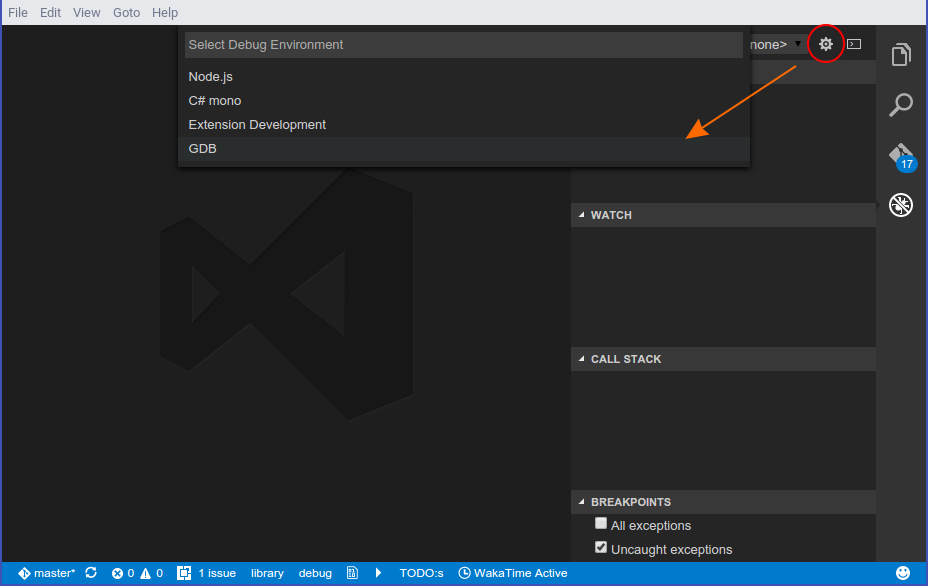
Open your project and click the debug button in your sidebar. At the top right press the little gear icon and select GDB. It will automatically generate the configuration you need.
Now you need to change target to the application you want to debug relative
to the cwd. (Which is the workspace root by default)
Before debugging you need to compile your application first, then you can run it using
the green start button in the debug sidebar. For this you could use the preLaunchTask
argument vscode allows you to do. Debugging multithreaded applications is currently not
implemented. Adding breakpoints while the program runs will not interrupt it immediately.
For that you need to pause & resume the program once first. However adding breakpoints
while its paused works as expected.
Extending variables is very limited as it does not support child values of variables.
Watching expressions works partially but the result does not get properly parsed and
it shows the raw GDB output of the command. It will run data-evaluate-expression
to check for variables.
While running you will get a console where you can manually type GDB commands or GDB/MI
commands prepended with a hyphen -. The console shows all output GDB gives separated
in stdout for the application, stderr for errors and log for GDB log messages.
Some exceptions/signals like segmentation faults will be catched and displayed but it does not support for example most D exceptions.
Attaching to existing processes
Attaching to existing processes currently only works by specifying the PID in the
launch.json and setting request to "attach". You also need to specify the executable
path for GDB to find the debug symbols.
"request": "attach",
"executable": "./bin/executable",
"target": "4285"
This will attach to PID 4285 which should already run. GDB will pause the program on entering.
Using gdbserver for remote debugging
You can also connect to a gdbserver instance and debug using that. For that modify the
launch.json by setting request to "attach" and remote to true and specifing the
port and optionally hostname in target.
"request": "attach",
"executable": "./bin/executable",
"target": ":2345",
"remote": true
This will attach to the running process managed by gdbserver on localhost:2345. You might need to hit the start button in the debug bar at the top first to start the program.
Using ssh for remote debugging
Debugging using ssh automatically converts all paths between client & server and also optionally
redirects X11 output from the server to the client. Simply add a ssh object in your launch
request.
"request": "launch",
"target": "./executable",
"cwd": "${workspaceRoot}",
"ssh": {
	"forwardX11": true,
	"host": "192.168.178.57",
	"cwd": "/home/remoteUser/project/",
	"keyfile": "/path/to/.ssh/key", // OR
	"password": "password123",
	"user": "remoteUser",
	"x11host": "localhost",
	"x11port": 6000
}
cwd will be used to trim off local paths and ssh.cwd will map them to the server. This is
required for basically everything except watched variables or user commands to work.
For X11 forwarding to work you first need to enable it in your Display Manager and allow the
connections. To allow connections you can either add an entry for applications or run xhost +
in the console while you are debugging and turn it off again when you are done using xhost -.