Langflow is a powerful tool for building and deploying AI-powered agents and workflows.
http://www.langflow.org
 270f609fe7
* Add `required_inputs` field to `Output` model in `base.py` * Refactor ComponentTool to ComponentToolkit and enhance tool creation logic - Replaced `ComponentTool` with `ComponentToolkit` to better encapsulate component-related tools. - Introduced `build_description` and `_build_output_function` helper functions for dynamic tool creation. - Updated tool initialization to handle multiple outputs and required inputs using `StructuredTool`. - Improved schema creation for tool arguments based on component inputs. * Refactor `to_tool` method to `to_toolkit` to use `ComponentToolkit` instead of `ComponentTool` * Refactor `ComponentTool` to `ComponentToolkit` in unit tests - Updated import statements to reflect the new `ComponentToolkit` class. - Modified test logic to use `ComponentToolkit` for retrieving tools. - Adjusted assertions to match the new structure and output format. - Ensured compatibility with `Message` schema for output validation. * Refactor `test_component_to_tool` to validate `ComponentToolkit` and tool properties * Refactor `build_description` to include input types in the output format * Add method to set required inputs for outputs based on method analysis - Introduced `_set_output_required_inputs` method to determine and set required inputs for each output by analyzing the method's source code. - Added necessary imports (`ast` and `dedent`) to support the new functionality. * Update test to assert full tool description in test_component_to_tool.py * Add unit tests for verifying required inputs of various components - Added tests to ensure that required inputs for outputs are present in the inputs of `ChatInput`, `ChatOutput`, `SequentialTaskComponent`, `ToolCallingAgentComponent`, and `OpenAIModelComponent`. - Included helper functions to check if required inputs are in inputs and to assert that all outputs have different required inputs. * Add RequiredInputsVisitor to identify required inputs in AST nodes - Introduced RequiredInputsVisitor class to traverse AST nodes and collect required inputs. - The visitor checks for 'self' attributes matching the provided inputs and adds them to the required_inputs set. * Refactor required inputs extraction using `RequiredInputsVisitor` * Add feature flags configuration for toolkit output in settings * Add toolkit output handling based on feature flag in custom component utils * Add method to append 'component_as_tool' output in custom component * Add unit test for toolkit output feature flag in custom component * Add utility functions for lazy loading and instantiating input types in langflow - Introduced `get_InputTypesMap` for lazy loading of `InputTypesMap`. - Added `instantiate_input` function to create instances of input types dynamically. - Included type checking and error handling for invalid input types. * Refactor input instantiation logic and update imports - Removed `instantiate_input` function from `inputs.py` and moved it to `utils.py`. - Updated imports in `base.py` to reflect the new location of `instantiate_input`. - Added missing import for `Callable` in `base.py`. * Refactor import statement to use `instantiate_input` from `langflow.inputs.utils` in test_inputs.py * Add TOOL_OUTPUT_NAME constant to tools module * Add type checking and TOOL_OUTPUT_NAME filter in ComponentToolkit - Introduced `TYPE_CHECKING` for type hints to avoid circular imports. - Added `TOOL_OUTPUT_NAME` constant to filter specific outputs in `ComponentToolkit`. - Updated type annotations to use forward references. * Refactor component toolkit import to avoid circular dependency and use constant for tool output name * Refactor `ComponentToolkit` class to remove inheritance from `BaseToolkit` and add an initializer for `component` * Add unit test for ComponentToolkit in test_component_to_tool - Added `test_component_to_tool_has_no_component_as_tool` to verify that `ComponentToolkit` correctly initializes with a `ChatInput` component and returns the expected tools. * Refactor toolkit output handling to `custom_component` module * fix: mypy errors union-attr and arg-type * Add 'OTHER' field type to schema in langflow/io/schema.py * Add tool name formatting to ComponentToolkit to ensure valid characters * Refactor toolkit output handling and add type hint for `to_toolkit` method * Add `is_interface_component` attribute to vertex types and update import order * Add tests for ToolCallingAgentComponent and ChatOutput with API key handling - Updated `test_component_tool` to reflect new description format. - Added `test_component_tool_with_api_key` to test `ToolCallingAgentComponent` with `ChatOutput` and OpenAI API key. - Enabled `add_toolkit_output` feature flag for testing. * Refactor `_find_matching_output_method` to accept `input_name` parameter for more precise input-output matching * Replace ValueError with warning in build_description function * use chat_output component directly in set * [autofix.ci] apply automated fixes * [autofix.ci] apply automated fixes * [autofix.ci] apply automated fixes (attempt 3/3) * Refactor: Reorder method calls in `__init__` for logical consistency Moved `set_class_code` method call to ensure output types and required inputs are set before class code initialization. * Update _format_tool_name to allow '.' in tool names * Refactor `_format_tool_name` to remove non-alphanumeric characters * Update test assertions for component tool name and output mapping * Handle case where 'required_inputs' is empty in 'component_tool.py' * Refactor import statements for better readability in `base.py` * [autofix.ci] apply automated fixes * Add noqa comment to suppress import warning and re-add Any import in base.py --------- Co-authored-by: italojohnny <italojohnnydosanjos@gmail.com> Co-authored-by: autofix-ci[bot] <114827586+autofix-ci[bot]@users.noreply.github.com> |
||
|---|---|---|
| .devcontainer | ||
| .github | ||
| .vscode | ||
| deploy | ||
| docker | ||
| docker_example | ||
| docs | ||
| scripts | ||
| src | ||
| .env.example | ||
| .eslintrc.json | ||
| .gitattributes | ||
| .gitignore | ||
| .pre-commit-config.yaml | ||
| CODE_OF_CONDUCT.md | ||
| CONTRIBUTING.md | ||
| eslint.config.js | ||
| LICENSE | ||
| Makefile | ||
| poetry.lock | ||
| pyproject.toml | ||
| README.ES.md | ||
| README.ja.md | ||
| README.KR.md | ||
| README.md | ||
| README.PT.md | ||
| README.zh_CN.md | ||
| render.yaml | ||
| uv.lock | ||
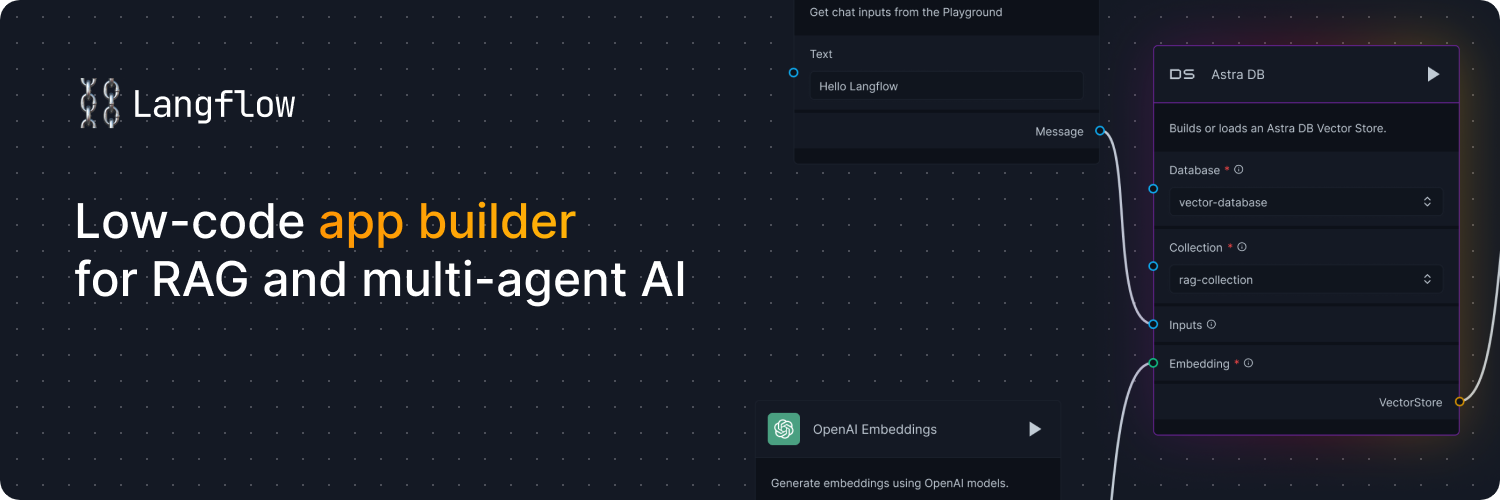
Langflow is a low-code app builder for RAG and multi-agent AI applications. It’s Python-based and agnostic to any model, API, or database.
Docs - Free Cloud Service - Self Managed


✨ Core features
- Python-based and agnostic to models, APIs, data sources, or databases.
- Visual IDE for drag-and-drop building and testing of workflows.
- Playground to immediately test and iterate workflows with step-by-step control.
- Multi-agent orchestration and conversation management and retrieval.
- Free cloud service to get started in minutes with no setup.
- Publish as an API or export as a Python application.
- Observability with LangSmith, LangFuse, or LangWatch integration.
- Enterprise-grade security and scalability with free DataStax Langflow cloud service.
- Customize workflows or create flows entirely just using Python.
- Ecosystem integrations as reusable components for any model, API or database.
📦 Quickstart
- Install with pip (Python 3.10 or greater):
pip install langflow
- Cloud: DataStax Langflow is a hosted environment with zero setup. Sign up for a free account.
- Self-managed: Run Langflow in your environment. Install Langflow to run a local Langflow server, and then use the Quickstart guide to create and execute a flow.
- Hugging Face: Clone the space using this link to create a Langflow workspace.
⭐ Stay up-to-date
Star Langflow on GitHub to be instantly notified of new releases.
👋 Contribute
We welcome contributions from developers of all levels. If you'd like to contribute, please check our contributing guidelines and help make Langflow more accessible.