Langflow is a powerful tool for building and deploying AI-powered agents and workflows.
http://www.langflow.org
 43ad226ddb
* fix dev dependencies * fix dev dependencies * update lock * Add langchain-unstructured dependency to pyproject.toml * Switch to uv-based Docker image and streamline build process - Use `ghcr.io/astral-sh/uv:python3.12-bookworm-slim` as the base image - Simplify environment variable setup and remove unnecessary ones - Install project dependencies using `uv sync` with cache mounts - Add and copy necessary files for the build process - Update npm installation and frontend build steps - Adjust entrypoint and runtime configurations - Remove redundant user setup and streamline CMD execution * Refactor Dockerfile to use multi-stage builds for optimized image size - Introduce a builder stage to install dependencies and build the frontend. - Use npm ci instead of npm install for more reliable builds. - Copy built frontend assets to the final image. - Transition to a runtime stage with a slimmer Python base image. - Ensure the final image only contains necessary runtime dependencies. * Switch base image to `ghcr.io/astral-sh/uv:python3.12-bookworm-slim` and update Dockerfile - Replace `python:3.12.3-slim` with `ghcr.io/astral-sh/uv:python3.12-bookworm-slim` as the base image. - Enable bytecode compilation and set link mode to copy. - Update dependency installation process using `uv sync`. - Simplify frontend build and copy process. - Add OCI labels for image metadata. - Update CMD to use `langflow-base` for running the application. * Update Dockerfile to use uv base image and optimize dependency installation - Switch base image to `ghcr.io/astral-sh/uv:python3.12-bookworm-slim` - Combine apt-get commands and clean up to reduce image size - Replace Poetry with uv for dependency management and caching * Refactor Dockerfile to use multi-stage build for optimized image size - Introduce a builder stage using `ghcr.io/astral-sh/uv:python3.12-bookworm-slim` - Add a runtime stage using `python:3.12.3-slim` - Copy the virtual environment from the builder stage to the runtime stage - Remove the `uv` entrypoint to avoid invoking it by default * Update Dockerfile: Fix indentation and remove redundant ENTRYPOINT reset * ci: update release workflows to use uv (#3919) * Update nightly build workflow to use 'uv' for dependency management and caching - Replace Poetry with 'uv' for dependency installation and project setup - Add steps to install 'uv' and set up caching for 'uv.lock' - Modify Python setup to use version specified in 'pyproject.toml' - Remove Node.js setup steps * Update release workflow to use uv for dependency management - Replace Poetry with uv for dependency installation and caching - Update Python setup to use version specified in pyproject.toml - Add steps to restore uv cache and install project dependencies using uv - Adjust publish steps to maintain functionality with new setup * Replace 'poetry publish' with 'uv publish' in Makefile for consistency * Update nightly build workflow to use 'uv' for dependency management and caching * Set up Node.js 20 in release_nightly workflow and update version verification logic * Update Makefile to use `uv sync --frozen` for backend dependencies installation * Update Makefile to pass arguments to 'uv build' and remove '--skip-existing' from publish commands - Modified 'build_langflow' target to accept arguments. - Removed '--skip-existing' from 'publish_base' and 'publish_base_testpypi' commands. - Added TODO comments for updating test-pypi repository usage. * Remove --skip-existing flag from uv publish commands and add TODO comments for test-pypi updates * new lock * Update CI workflow to remove version prefix and add build args - Removed 'v' prefix from version extraction in nightly release workflow. - Added '--no-sources' argument to the build command in the distribution step. * Update CI workflow to use 'uv' for versioning and publishing - Replace 'poetry' with 'uv' for version extraction in release checks * Update CI workflow to use UV_PUBLISH_TOKEN for PyPI publishing * Add verification step for 'langflow-nightly' name and version in CI workflow - Corrected awk commands for extracting 'langflow-base' name and version. - Added a new step to verify 'langflow-nightly' name and version against expected values. * feat: Update dev.Dockerfile to use 'uv' for dependency management and caching * update dockerfiles with --no-editable --------- Co-authored-by: phact <estevezsebastian@gmail.com> Co-authored-by: Jordan Frazier <jordan.frazier@datastax.com> |
||
|---|---|---|
| .devcontainer | ||
| .github | ||
| .vscode | ||
| deploy | ||
| docker | ||
| docker_example | ||
| docs | ||
| scripts | ||
| src | ||
| .env.example | ||
| .eslintrc.json | ||
| .gitattributes | ||
| .gitignore | ||
| .pre-commit-config.yaml | ||
| CODE_OF_CONDUCT.md | ||
| CONTRIBUTING.md | ||
| eslint.config.js | ||
| LICENSE | ||
| Makefile | ||
| poetry.lock | ||
| pyproject.toml | ||
| README.ES.md | ||
| README.ja.md | ||
| README.KR.md | ||
| README.md | ||
| README.PT.md | ||
| README.zh_CN.md | ||
| render.yaml | ||
| uv.lock | ||
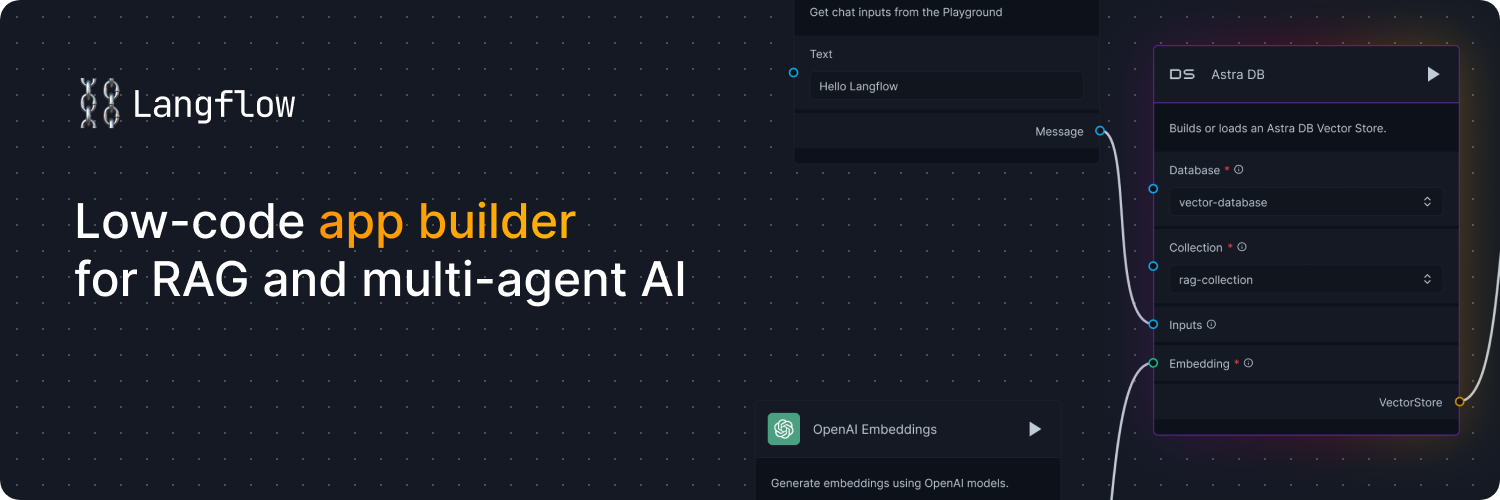
Langflow is a low-code app builder for RAG and multi-agent AI applications. It’s Python-based and agnostic to any model, API, or database.
Docs - Free Cloud Service - Self Managed


✨ Core features
- Python-based and agnostic to models, APIs, data sources, or databases.
- Visual IDE for drag-and-drop building and testing of workflows.
- Playground to immediately test and iterate workflows with step-by-step control.
- Multi-agent orchestration and conversation management and retrieval.
- Free cloud service to get started in minutes with no setup.
- Publish as an API or export as a Python application.
- Observability with LangSmith, LangFuse, or LangWatch integration.
- Enterprise-grade security and scalability with free DataStax Langflow cloud service.
- Customize workflows or create flows entirely just using Python.
- Ecosystem integrations as reusable components for any model, API or database.
📦 Quickstart
- Install with pip (Python 3.10 or greater):
pip install langflow
- Cloud: DataStax Langflow is a hosted environment with zero setup. Sign up for a free account.
- Self-managed: Run Langflow in your environment. Install Langflow to run a local Langflow server, and then use the Quickstart guide to create and execute a flow.
- Hugging Face: Clone the space using this link to create a Langflow workspace.
⭐ Stay up-to-date
Star Langflow on GitHub to be instantly notified of new releases.
👋 Contribute
We welcome contributions from developers of all levels. If you'd like to contribute, please check our contributing guidelines and help make Langflow more accessible.