 86ca23397e
* refactor: update code references to use _code instead of code * refactor: add backwards compatible attributes to Component class * refactor: update Component constructor to pass config params with underscore Refactored the `Component` class in `component.py` to handle inputs and outputs. Added a new method `map_outputs` to map a list of outputs to the component. Also updated the `__init__` method to properly initialize the inputs, outputs, and other attributes. This change improves the flexibility and extensibility of the `Component` class. Co-authored-by: Gabriel Luiz Freitas Almeida <gabriel@langflow.org> * refactor: change attribute to use underscore * refactor: update CustomComponent initialization parameters Refactored the `instantiate_class` function in `loading.py` to update the initialization parameters for the `CustomComponent` class. Changed the parameter names from `user_id`, `parameters`, `vertex`, and `tracing_service` to `_user_id`, `_parameters`, `_vertex`, and `_tracing_service` respectively. This change ensures consistency and improves code readability. Co-authored-by: Gabriel Luiz Freitas Almeida <gabriel@langflow.org> * refactor: update BaseComponent to accept UUID for _user_id Updated the `BaseComponent` class in `base_component.py` to accept a `UUID` type for the `_user_id` attribute. This change improves the type safety and ensures consistency with the usage of `_user_id` throughout the codebase. * refactor: import nanoid with type annotation The `nanoid` import in `component.py` has been updated to include a type annotation `# type: ignore`. This change ensures that the type checker ignores any errors related to the `nanoid` import. * fix(custom_component.py): convert _user_id to string before passing to functions to ensure compatibility with function signatures * feat(component.py): add method to set output types based on method return type to improve type checking and validation in custom components * refactor: extract method to get method return type in CustomComponent * refactor(utils.py): refactor code to use _user_id instead of user_id for consistency and clarity perf(utils.py): optimize code by reusing cc_instance instead of calling get_component_instance multiple times * refactor(utils.py, base.py): change parameter name 'add_name' to 'keep_name' for clarity and consistency in codebase * [autofix.ci] apply automated fixes * refactor: update schema.py to include Edge related typres The `schema.py` file in the `src/backend/base/langflow/graph/edge` directory has been updated to include the `TargetHandle` and `SourceHandle` models. These models define the structure and attributes of the target and source handles used in the edge data. This change improves the clarity and consistency of the codebase. * refactor: update BaseInputMixin to handle invalid field types gracefully The `BaseInputMixin` class in `input_mixin.py` has been updated to handle invalid field types gracefully. Instead of raising an exception, it now returns `FieldTypes.OTHER` for any invalid field type. This change improves the robustness and reliability of the codebase. * refactor: update file_types field alias in FileMixin The `file_types` field in the `FileMixin` class of `input_mixin.py` has been updated to use the `alias` parameter instead of `serialization_alias`. This change ensures consistency and improves the clarity of the codebase. * refactor(inputs): update field_type declarations in various input classes to use SerializableFieldTypes enum for better type safety and clarity * refactor(inputs): convert dict to Message object in _validate_value method * refactor(inputs): convert dict to Message object in _validate_value method * refactor(inputs): update model_config in BaseInputMixin to enable populating by name The `model_config` attribute in the `BaseInputMixin` class of `input_mixin.py` has been updated to include the `populate_by_name=True` parameter. This change allows the model configuration to be populated by name, improving the flexibility and usability of the codebase. * refactor: update _extract_return_type method in CustomComponent to accept Any type The _extract_return_type method in CustomComponent has been updated to accept the Any type as the return_type parameter. This change improves the flexibility and compatibility of the method, allowing it to handle a wider range of return types. * refactor(component): add get_input and get_output methods for easier access to input and output values The `Component` class in `component.py` has been updated to include the `get_input` and `get_output` methods. These methods allow for easier retrieval of input and output values by name, improving the usability and readability of the codebase. * refactor(vertex): add get_input and get_output methods for easier access to input and output values * refactor(component): add set_output_value method for easier modification of output values The `Component` class in `component.py` has been updated to include the `set_output_value` method. This method allows for easier modification of output values by name, improving the usability and flexibility of the codebase. * feat: add run_until_complete and run_in_thread functions for handling asyncio tasks The `async_helpers.py` file in the `src/backend/base/langflow/utils` directory has been added. This file includes the `run_until_complete` and `run_in_thread` functions, which provide a way to handle asyncio tasks in different scenarios. The `run_until_complete` function checks if an event loop is already running and either runs the coroutine in a separate event loop in a new thread or creates a new event loop and runs the coroutine. The `run_in_thread` function runs the coroutine in a separate thread and returns the result or raises an exception if one occurs. These functions improve the flexibility and usability of the codebase. * refactor(component): add _edges attribute to Component class for managing edges The `Component` class in `component.py` has been updated to include the `_edges` attribute. This attribute is a list of `EdgeData` objects and is used for managing edges in the component. This change improves the functionality and organization of the codebase. * fix(component.py): fix conditional statement to check if self._vertex is not None before accessing its attributes * refactor(component): add _get_fallback_input method for handling fallback input The `Component` class in `component.py` has been updated to include the `_get_fallback_input` method. This method returns an `Input` object with the provided keyword arguments, which is used as a fallback input when needed. This change improves the flexibility and readability of the codebase. * refactor(component): add TYPE_CHECKING import for Vertex in component.py * refactor(component): add _map_parameters_on_frontend_node and _map_parameters_on_template and other methods The `Component` class in `component.py` has been refactored to include the `_map_parameters_on_frontend_node` and `_map_parameters_on_template` methods. These methods are responsible for mapping the parameters of the component onto the frontend node and template, respectively. This change improves the organization and maintainability of the codebase. * refactor(component): Add map_inputs and map_outputs methods for mapping inputs and outputs The `Component` class in `component.py` has been updated to include the `map_inputs` and `map_outputs` methods. These methods allow for mapping the given inputs and outputs to the component, improving the functionality and organization of the codebase. * refactor(component): Add Input, Output, and ComponentFrontendNode imports and run_until_complete function This commit refactors the `component.py` file in the `src/backend/base/langflow/custom/custom_component` directory. It adds the `Input`, `Output`, and `ComponentFrontendNode` imports, as well as the `run_until_complete` function from the `async_helpers.py` file. These changes improve the functionality and organization of the codebase. * refactor(component): Add map_inputs and map_outputs methods for mapping inputs and outputs * refactor(component): Add _process_connection_or_parameter method for handling connections and parameters The `Component` class in `component.py` has been updated to include the `_process_connection_or_parameter` method. This method is responsible for handling connections and parameters based on the provided key and value. It checks if the value is callable and connects it to the component, otherwise it sets the parameter or attribute. This change improves the functionality and organization of the codebase. * refactor(frontend_node): Add set_field_value_in_template method for updating field values The `FrontendNode` class in `base.py` has been updated to include the `set_field_value_in_template` method. This method allows for updating the value of a specific field in the template of the frontend node. It iterates through the fields and sets the value of the field with the provided name. This change improves the flexibility and functionality of the codebase. * refactor(inputs): Add DefaultPromptField class for default prompt inputs The `inputs.py` file in the `src/backend/base/langflow/inputs` directory has been refactored to include the `DefaultPromptField` class. This class represents a default prompt input with customizable properties such as name, display name, field type, advanced flag, multiline flag, input types, and value. This change improves the flexibility and functionality of the codebase. * feat: Add Template.from_dict method for creating Template objects from dictionaries This commit adds the `from_dict` class method to the `Template` class in `base.py`. This method allows for creating `Template` objects from dictionaries by converting the dictionary keys and values into the appropriate `Template` attributes. This change improves the flexibility and functionality of the codebase. * refactor(frontend_node): Add from_dict method for creating FrontendNode objects from dictionaries * refactor: update BaseComponent to use get_template_config method Refactored the `BaseComponent` class in `base_component.py` to use the `get_template_config` method instead of duplicating the code. This change improves code readability and reduces redundancy. * refactor(graph): Add EdgeData import and update add_nodes_and_edges method signature The `Graph` class in `base.py` has been updated to include the `EdgeData` import and modify the signature of the `add_nodes_and_edges` method. The `add_nodes_and_edges` method now accepts a list of dictionaries representing `EdgeData` objects instead of a list of dictionaries with string keys and values. This change improves the type safety and clarity of the codebase. * refactor(graph): Add first_layer property to Graph class The `Graph` class in `base.py` has been updated to include the `first_layer` property. This property returns the first layer of the graph and throws a `ValueError` if the graph is not prepared. This change improves the functionality and organization of the codebase. * refactor(graph): Update Graph class instantiation in base.py The `Graph` class in `base.py` has been updated to use keyword arguments when instantiating the class. This change improves the readability and maintainability of the codebase. * refactor(graph): Add prepare method to Graph class The `Graph` class in `base.py` has been updated to include the `prepare` method. This method prepares the graph for execution by validating the stream, building edges, and sorting vertices. It also adds the first layer of vertices to the run manager and sets the run queue. This change improves the functionality and organization of the codebase. * refactor(graph): Improve graph preparation in retrieve_vertices_order function The `retrieve_vertices_order` function in `chat.py` has been updated to improve the graph preparation process. Instead of manually sorting vertices and adding them to the run manager, the function now calls the `prepare` method of the `Graph` class. This method validates the stream, builds edges, and sets the first layer of vertices. This change improves the functionality and organization of the codebase. * refactor: Add GetCache and SetCache protocols for caching functionality * refactor(graph): Add VertexBuildResult class for representing vertex build results * refactor(chat.py, base.py): update build_vertex method in chat.py and base.py * refactor(graph): Update Edge and ContractEdge constructors to use EdgeData type The constructors of the `Edge` and `ContractEdge` classes in `base.py` have been updated to use the `EdgeData` type for the `edge` and `raw_edge` parameters, respectively. This change improves the type safety and clarity of the codebase. * feat: add BaseModel class with model_config attribute A new `BaseModel` class has been added to the `base_model.py` file. This class extends the `PydanticBaseModel` and includes a `model_config` attribute of type `ConfigDict`. This change improves the codebase by providing a base model with a configuration dictionary for models. Co-authored-by: Gabriel Luiz Freitas Almeida <gabriel@langflow.org> * refactor: update langflow.graph.edge.schema.py Refactor the `langflow.graph.edge.schema.py` file to include the `TargetHandle` and `SourceHandle` models. This change improves the clarity and consistency of the codebase. Co-authored-by: Gabriel Luiz Freitas Almeida <gabriel@langflow.org> * refactor(base): Update target_param assignment in Edge class The `target_param` assignment in the `Edge` class of `base.py` has been updated to use the `cast` function for type hinting. This change improves the type safety and clarity of the codebase. * refactor(base): Add check for existing type in add_types method * refactor: update build_custom_component_template to use add_name instead of keep_name Refactor the `build_custom_component_template` function in `utils.py` to use the `add_name` parameter instead of the deprecated `keep_name` parameter. This change ensures consistency with the updated method signature and improves code clarity. * feat(component.py): add method to set output types based on method return type to improve type checking and validation in custom components (#3115) * feat(component.py): add method to set output types based on method return type to improve type checking and validation in custom components * refactor: extract method to get method return type in CustomComponent * refactor: update _extract_return_type method in CustomComponent to accept Any type The _extract_return_type method in CustomComponent has been updated to accept the Any type as the return_type parameter. This change improves the flexibility and compatibility of the method, allowing it to handle a wider range of return types. * refactor: add _template_config property to BaseComponent Add a new `_template_config` property to the `BaseComponent` class in `base_component.py`. This property is used to store the template configuration for the custom component. If the `_template_config` property is empty, it is populated by calling the `build_template_config` method. This change improves the efficiency of accessing the template configuration and ensures that it is only built when needed. * refactor: add type checking for Output types in add_types method Improve type checking in the `add_types` method of the `Output` class in `base.py`. Check if the `type_` already exists in the `types` list before adding it. This change ensures that duplicate types are not added to the list. * update starter projects * refactor: optimize imports in base.py Optimize imports in the `base.py` file by removing unused imports and organizing the remaining imports. This change improves code readability and reduces unnecessary clutter. * fix(base.py): fix condition to check if self.types is not None before checking if type_ is in self.types * refactor: update build_custom_component_template to use add_name instead of keep_name * refactor(prompts): Update PromptComponent to support custom fields and template updates The `PromptComponent` class in `Prompt.py` has been updated to support custom fields and template updates. The `_update_template` method has been added to update the prompt template with custom fields. The `post_code_processing` method has been modified to update the template and improve backwards compatibility. The `_get_fallback_input` method has been added to provide a default prompt field. These changes improve the functionality and flexibility of the codebase. * refactor(base): Add DefaultPromptField to langflow.io The `DefaultPromptField` class has been added to the `langflow.io` module. This class provides a default prompt field for the `TableInput` class. This change improves the functionality and flexibility of the codebase. * refactor(prompts): Update PromptComponent to support custom fields and template updates * refactor(base): Update langflow.template.field.prompt.py for backwards compatibility * refactor(base): Update langflow.components.__init__.py to import the prompts module This change adds the prompts module to the list of imports in the __init__.py file of the langflow.components package. This ensures that the prompts module is available for use in the codebase. * refactor(base): Update langflow.template.field.prompt.py for backwards compatibility * refactor(graph): Update VertexTypesDict to import vertex types lazily The VertexTypesDict class in constants.py has been updated to import vertex types lazily. This change improves the performance of the codebase by deferring the import until it is actually needed. * refactor(graph): Add missing attributes and lock to Graph class The Graph class in base.py has been updated to add missing attributes and a lock. This change ensures that the necessary attributes are initialized and provides thread safety with the addition of a lock. It improves the functionality and reliability of the codebase. * refactor(graph): Add method to set inputs in Graph class The `_set_inputs` method has been added to the Graph class in base.py. This method allows for setting inputs for specific vertices based on input components, inputs, and input type. It improves the functionality and flexibility of the codebase. * refactor(graph): Set inputs for specific vertices in Graph class The `_set_inputs` method has been added to the Graph class in base.py. This method allows for setting inputs for specific vertices based on input components, inputs, and input type. It improves the functionality and flexibility of the codebase. * refactor(graph): Update Graph class to set cache using flow_id The `Graph` class in `base.py` has been updated to set the cache using the `flow_id` attribute. This change ensures that the cache is properly set when `cache` is enabled and `flow_id` is not None. It improves the functionality and reliability of the codebase. * refactor(graph): Refactor Graph class to improve edge building The `Graph` class in `base.py` has been refactored to improve the process of building edges. The `build_edge` method has been added to encapsulate the logic of creating a `ContractEdge` object from the given `EdgeData`. This change enhances the readability and maintainability of the codebase. * refactor(graph): Update _create_vertex method parameter name for clarity The `_create_vertex` method in the `Graph` class of `base.py` has been updated to change the parameter name from `vertex` to `frontend_data` for improved clarity. This change enhances the readability and maintainability of the codebase. * refactor(graph): Update Graph class to return first layer in sort_interface_components_first The `sort_interface_components_first` method in the `Graph` class of `base.py` has been updated to return just the first layer of vertices. This change improves the functionality of the codebase by providing a more focused and efficient sorting mechanism. * refactor(graph): Update Graph class to use get_vertex method for building vertices The _build_vertices method in the Graph class of base.py has been updated to use the get_vertex method instead of creating a new vertex instance. This change improves the efficiency and maintainability of the codebase. * refactor(graph): Update Graph class to use astep method for asynchronous execution The `Graph` class in `base.py` has been updated to use the `astep` method for asynchronous execution of vertices. This change improves the efficiency and maintainability of the codebase by leveraging asyncio and allowing for concurrent execution of vertices. * feat(base.py): implement methods to add components and component edges in the Graph class * refactor(graph): Import nest_asyncio for asynchronous execution in Graph class * refactor(base.py): Update Vertex class to handle parameter dictionaries in build_params The `build_params` method in the `Vertex` class of `base.py` has been updated to handle parameter dictionaries correctly. If the `param_dict` is empty or has more than one key, the method now sets the parameter value to the vertex that is the source of the edge. Otherwise, it sets the parameter value to a dictionary with keys corresponding to the keys in the `param_dict` and values as the vertex that is the source of the edge. This change improves the functionality and maintainability of the codebase. * refactor(base.py): Add methods to set input values and add component instances in Vertex class The `Vertex` class in `base.py` has been refactored to include two new methods: `set_input_value` and `add_component_instance`. The `set_input_value` method allows setting input values for a vertex by name, while the `add_component_instance` method adds a component instance to the vertex. These changes enhance the functionality and maintainability of the codebase. * refactor(message.py): Update _timestamp_to_str to handle datetime or str input The `_timestamp_to_str` function in `message.py` has been updated to handle both `datetime` and `str` input. If the input is a `datetime` object, it will be formatted as a string using the "%Y-%m-%d %H:%M:%S" format. If the input is already a string, it will be returned as is. This change improves the flexibility and usability of the function. * refactor(test_base.py): Add unit tests for Graph class Unit tests have been added to the `test_base.py` file to test the functionality of the `Graph` class. These tests ensure that the graph is prepared correctly, components are added and connected properly, and the graph executes as expected. This change improves the reliability and maintainability of the codebase. * refactor(initialize/loading.py): Refactor get_instance_results function The `get_instance_results` function in `initialize/loading.py` has been refactored to simplify the logic for building custom components and components. The previous implementation had separate checks for `CustomComponent` and `Component` types, but the refactored version combines these checks into a single condition based on the `base_type` parameter. This change improves the readability and maintainability of the codebase. * refactor(component.py): Add set_input_value method to Component class The `set_input_value` method has been added to the `Component` class in `component.py`. This method allows setting the value of an input by name, and also updates the `load_from_db` attribute if applicable. This change enhances the functionality and maintainability of the codebase. * refactor(component.py): Set input value in _set_parameter_or_attribute method The `_set_parameter_or_attribute` method in the `Component` class now sets the input value using the `set_input_value` method. This change improves the clarity and consistency of the codebase. * refactor(inputs.py): Improve error message for invalid value type The `SecretStrInput` class in `inputs.py` has been updated to improve the error message when an invalid value type is encountered. Instead of a generic error message, the new message includes the specific value type and the name of the input. This change enhances the clarity and usability of the codebase. * feat: Add unit test for memory chatbot functionality * refactor(base.py): Update __repr__ method in ContractEdge class The `__repr__` method in the `ContractEdge` class of `base.py` has been updated to include the source handle and target handle information when available. This change improves the readability and clarity of the representation of the edge in the codebase. * refactor(component.py): Update set method to return self The `set` method in the `Component` class of `component.py` has been updated to return `self` after processing the connection or parameter. This change improves the chaining capability of the method and enhances the readability and consistency of the codebase. * refactor(starter_projects): Add unit test for vector store RAG A unit test has been added to the `test_vector_store_rag.py` file in the `starter_projects` directory. This test ensures that the vector store RAG graph is set up correctly and produces the expected results. This change improves the reliability and maintainability of the codebase. * refactor: remove unused prepare method in Graph class * refactor: update Output class to use list[str] for types field * refactor: add name validation to BaseInputMixin * refactor: update ContractEdge __repr__ method for improved readability and consistency * refactor: update BaseInputMixin to ensure name field is required with appropriate description * refactor: remove name validation from BaseInputMixin * refactor: update input tests to include 'name' field in all input types for better validation and clarity * refactor: enhance Component class with methods to validate callable outputs and inheritance checks for better robustness * refactor: disable load_from_db for inputs in Component class to improve input handling logic and prevent unwanted database loading * refactor: add test for setting invalid output in test_component.py --------- Co-authored-by: autofix-ci[bot] <114827586+autofix-ci[bot]@users.noreply.github.com> |
||
|---|---|---|
| .devcontainer | ||
| .github | ||
| .vscode | ||
| deploy | ||
| docker | ||
| docker_example | ||
| docs | ||
| scripts | ||
| src | ||
| .env.example | ||
| .eslintrc.json | ||
| .gitattributes | ||
| .gitignore | ||
| .pre-commit-config.yaml | ||
| CODE_OF_CONDUCT.md | ||
| CONTRIBUTING.md | ||
| eslint.config.js | ||
| LICENSE | ||
| Makefile | ||
| poetry.lock | ||
| pyproject.toml | ||
| README.ja.md | ||
| README.KR.md | ||
| README.md | ||
| README.PT.md | ||
| README.zh_CN.md | ||
| render.yaml | ||
Langflow 1.0 is OUT! 🎉
Read all about it here!
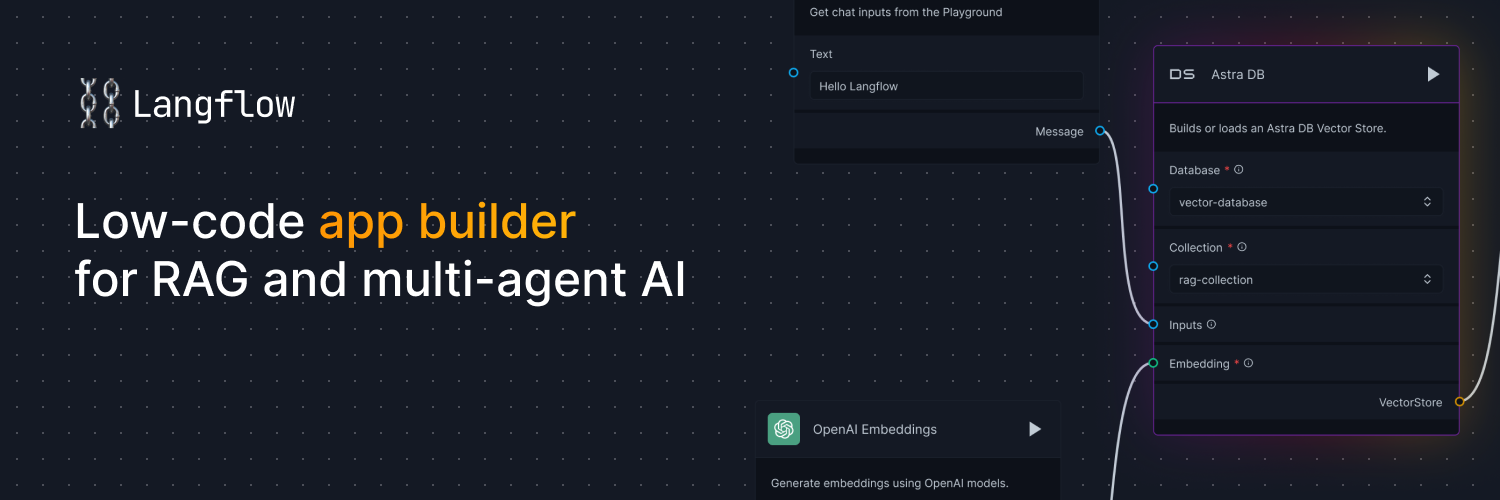
A visual framework for building multi-agent and RAG applications
Open-source, Python-powered, fully customizable, LLM and vector store agnostic
Docs - Join our Discord - Follow us on X - Live demo




📝 Content
- 📝 Content
- 📦 Get Started
- Running Langflow from a Cloned Repository
- 🎨 Create Flows
- Deploy
- 🖥️ Command Line Interface (CLI)
- 👋 Contribute
- 🌟 Contributors
- 📄 License
📦 Get Started
You can install Langflow with pip:
# Make sure you have >=Python 3.10 installed on your system.
python -m pip install langflow -U
Then, run Langflow with:
python -m langflow run
Running Langflow from a Cloned Repository
If you prefer to run Langflow from a cloned repository rather than installing it via pip, follow these steps:
- Clone the Repository
First, clone the Langflow repository from GitHub:
git clone https://github.com/langflow-ai/langflow.git
Navigate into the cloned directory:
cd langflow
- Build and Install Dependencies
To build and install Langflow’s frontend and backend, use the following commands:
make install_frontend && make build_frontend && make install_backend
- Run Langflow
Once the installation is complete, you can run Langflow with:
poetry run python -m langflow run
🎨 Create Flows
Creating flows with Langflow is easy. Simply drag components from the sidebar onto the workspace and connect them to start building your application.
Explore by editing prompt parameters, grouping components into a single high-level component, and building your own Custom Components.
Once you’re done, you can export your flow as a JSON file.
Load the flow with:
from langflow.load import run_flow_from_json

results = run_flow_from_json("path/to/flow.json", input_value="Hello, World!")
Deploy
DataStax Langflow
DataStax Langflow is a hosted version of Langflow integrated with AstraDB. Be up and running in minutes with no installation or setup required. Sign up for free.
Deploy Langflow on Hugging Face Spaces
You can also preview Langflow in HuggingFace Spaces. Clone the space using this link to create your own Langflow workspace in minutes.
Deploy Langflow on Google Cloud Platform
Follow our step-by-step guide to deploy Langflow on Google Cloud Platform (GCP) using Google Cloud Shell. The guide is available in the Langflow in Google Cloud Platform document.
Alternatively, click the "Open in Cloud Shell" button below to launch Google Cloud Shell, clone the Langflow repository, and start an interactive tutorial that will guide you through the process of setting up the necessary resources and deploying Langflow on your GCP project.

Deploy on Railway
Use this template to deploy Langflow 1.0 on Railway:

Deploy on Render

Deploy on Kubernetes
Follow our step-by-step guide to deploy Langflow on Kubernetes.
🖥️ Command Line Interface (CLI)
Langflow provides a command-line interface (CLI) for easy management and configuration.
Usage
You can run the Langflow using the following command:
langflow run [OPTIONS]
Each option is detailed below:
--help: Displays all available options.--host: Defines the host to bind the server to. Can be set using theLANGFLOW_HOSTenvironment variable. The default is127.0.0.1.--workers: Sets the number of worker processes. Can be set using theLANGFLOW_WORKERSenvironment variable. The default is1.--timeout: Sets the worker timeout in seconds. The default is60.--port: Sets the port to listen on. Can be set using theLANGFLOW_PORTenvironment variable. The default is7860.--env-file: Specifies the path to the .env file containing environment variables. The default is.env.--log-level: Defines the logging level. Can be set using theLANGFLOW_LOG_LEVELenvironment variable. The default iscritical.--components-path: Specifies the path to the directory containing custom components. Can be set using theLANGFLOW_COMPONENTS_PATHenvironment variable. The default islangflow/components.--log-file: Specifies the path to the log file. Can be set using theLANGFLOW_LOG_FILEenvironment variable. The default islogs/langflow.log.--cache: Selects the type of cache to use. Options areInMemoryCacheandSQLiteCache. Can be set using theLANGFLOW_LANGCHAIN_CACHEenvironment variable. The default isSQLiteCache.--dev/--no-dev: Toggles the development mode. The default isno-dev.--path: Specifies the path to the frontend directory containing build files. This option is for development purposes only. Can be set using theLANGFLOW_FRONTEND_PATHenvironment variable.--open-browser/--no-open-browser: Toggles the option to open the browser after starting the server. Can be set using theLANGFLOW_OPEN_BROWSERenvironment variable. The default isopen-browser.--remove-api-keys/--no-remove-api-keys: Toggles the option to remove API keys from the projects saved in the database. Can be set using theLANGFLOW_REMOVE_API_KEYSenvironment variable. The default isno-remove-api-keys.--install-completion [bash|zsh|fish|powershell|pwsh]: Installs completion for the specified shell.--show-completion [bash|zsh|fish|powershell|pwsh]: Shows completion for the specified shell, allowing you to copy it or customize the installation.--backend-only: This parameter, with a default value ofFalse, allows running only the backend server without the frontend. It can also be set using theLANGFLOW_BACKEND_ONLYenvironment variable.--store: This parameter, with a default value ofTrue, enables the store features, use--no-storeto deactivate it. It can be configured using theLANGFLOW_STOREenvironment variable.
These parameters are important for users who need to customize the behavior of Langflow, especially in development or specialized deployment scenarios.
Environment Variables
You can configure many of the CLI options using environment variables. These can be exported in your operating system or added to a .env file and loaded using the --env-file option.
A sample .env file named .env.example is included with the project. Copy this file to a new file named .env and replace the example values with your actual settings. If you're setting values in both your OS and the .env file, the .env settings will take precedence.
👋 Contribute
We welcome contributions from developers of all levels to our open-source project on GitHub. If you'd like to contribute, please check our contributing guidelines and help make Langflow more accessible.
🌟 Contributors
📄 License
Langflow is released under the MIT License. See the LICENSE file for details.