| debian | ||
| docker | ||
| examples | ||
| img | ||
| mimic3_http | ||
| mimic3_tts | ||
| opentts_abc | ||
| pyinstaller | ||
| scripts | ||
| tests | ||
| voices | ||
| wheels | ||
| .gitignore | ||
| .isort.cfg | ||
| .projectile | ||
| build-dist.sh | ||
| check.sh | ||
| Dockerfile | ||
| Dockerfile.debian | ||
| Dockerfile.debian.dockerignore | ||
| Dockerfile.dist | ||
| Dockerfile.dist.dockerignore | ||
| Dockerfile.dockerignore | ||
| Dockerfile.gpu | ||
| Dockerfile.gpu.dockerignore | ||
| Dockerfile.plugin | ||
| Dockerfile.plugin.dockerignore | ||
| Dockerfile.sample | ||
| Dockerfile.sample.dockerignore | ||
| install.sh | ||
| Jenkinsfile | ||
| LICENSE | ||
| Makefile | ||
| MANIFEST.in | ||
| mypy.ini | ||
| pylintrc | ||
| README.md | ||
| requirements.txt | ||
| requirements_dev.txt | ||
| setup.cfg | ||
| setup.py | ||
| test.sh | ||

Mimic 3
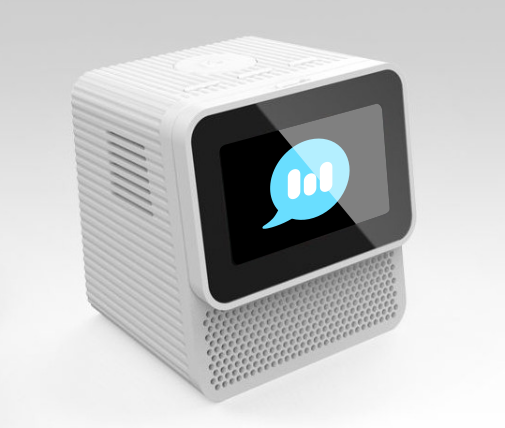
A fast and local neural text to speech system developed by Mycroft for the Mark II.
Use Cases
- Mycroft TTS plugin
mycroft-say 'Hello world.'
- Web server
curl -X POST --data 'Hello world.' --output - localhost:59125/api/tts | aplay- Drop-in replacement for MaryTTS
- Command-line tool
mimic3 'Hello world.' | aplay
- Voice for screen reader
spd-say 'Hello world.'
Dependencies
Mimic 3 requires:
- Python 3.7 or higher
- The Onnx runtime
- gruut or eSpeak-ng or epitran (depending on the voice)
Installation
eSpeak
Some voices depend on eSpeak-ng, specifically libespeak-ng.so. For those voices, make sure that libespeak-ng is installed with:
sudo apt-get install libespeak-ng1
On 32-bit ARM platforms (a.k.a. armv7l or armhf), you will also need some extra libraries:
sudo apt-get install libatomic1 libgomp1 libatlas-base-dev
Mycroft TTS Plugin
Install the plugin:
mycroft-pip install mycroft-plugin-tts-mimic3[all]
Enable the plugin in your mycroft.conf file:
mycroft-config set tts.module mimic3_tts_plug
or you can manually add the following to mycroft.conf with mycroft-config edit user:
"tts": {
  "module": "mimic3_tts_plug"
}
See the plugin's documentation for more options.
Docker image
A pre-built Docker image is available for the following platforms:
linux/amd64- For desktops and laptops (
x86_64CPUs)
- For desktops and laptops (
linux/arm64- For Raspberry 3/4 and Zero 2 with 64-bit Pi OS
linux/arm/v7- For Raspberry Pi 1/2/3/4 and Zero 2 with 32-bit Pi OS
Install/update with:
docker pull mycroftai/mimic3
Once installed, check out the following scripts for running:
Or you can manually run the web server with:
docker run \
       -it \
       -p 59125:59125 \
       -v "${HOME}/.local/share/mycroft/mimic3:/home/mimic3/.local/share/mycroft/mimic3" \
       'mycroftai/mimic3'
Voices will be automatically downloaded to ${HOME}/.local/share/mycroft/mimic3/voices
Debian Package
Grab the Debian package from the latest release for your platform:
mycroft-mimic3-tts_<version>_amd64.deb- For desktops and laptops (
x86_64CPUs)
- For desktops and laptops (
mycroft-mimic3-tts_<version>_arm64.deb- For Raspberry 3/4 and Zero 2 with 64-bit Pi OS
mycroft-mimic3-tts_<version>_armhf.deb- For Raspberry Pi 1/2/3/4 and Zero 2 with 32-bit Pi OS
Once downloaded, install the package with (note the ./):
sudo apt install ./mycroft-mimic3-tts_<version>_<platform>.deb
Once installed, the following commands will be available in /usr/bin:
mimic3mimic3-servermimic3-download
Using pip
Install the command-line tool:
pip install mycroft-mimic3-tts[all]
Once installed, the following commands will be available:
mimic3mimic3-downloadmimic3-server
Language support can be selectively installed by replacing all with:
de- Germanes- Spanishfa- Farsifr- Frenchit- Italiannl- Dutchru- Russiansw- Kiswahili
Excluding [..] entirely will install support for English only.
From Source
Clone the repository:
git clone https://github.com/MycroftAI/mimic3.git
Run the install script:
cd mimic3/
./install.sh
A virtual environment will be created in mimic3/.venv and each of the Python modules will be installed in editiable mode (pip install -e).
Once installed, the following commands will be available in .venv/bin:
mimic3mimic3-servermimic3-download
Voice Keys
Mimic 3 references voices with the format:
<language>_<region>/<dataset>_<quality>for single speaker voices, and<language>_<region>/<dataset>_<quality>#<speaker>for multi-speaker voices<speaker>can be a name or number starting at 0- Speaker names come from a voice's
speakers.txtfile
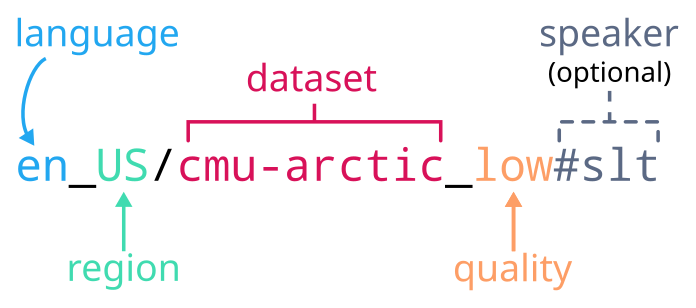
For example, the default Alan Pope voice key is en_UK/apope_low.
The CMU Arctic voice contains multiple speakers, with a commonly used voice being en_US/cmu-arctic_low#slt.
Voices are automatically downloaded from Github and stored in ${HOME}/.local/share/mycroft/mimic3 (technically ${XDG_DATA_HOME}/mycroft/mimic3). You can also manually download them.
Running
Command-Line Tools
The mimic3 command can be used to synthesize audio on the command line:
mimic3 --voice 'en_UK/apope_low' 'My hovercraft is full of eels.' > hovercraft_eels.wav
See voice keys for how to reference voices and speakers.
See mimic3 --help or the CLI documentation for more details.
Downloading Voices
Mimic 3 automatically downloads voices when they're first used, but you can manually download them too with mimic3-download.
For example:
mimic3-download 'en_US/*'
will download all U.S. English voices to ${HOME}/.local/share/mycroft/mimic3/voices.
See mimic3-download --help for more options.
Web Server and Client
Start a web server with mimic3-server and visit http://localhost:59125 to view the web UI.
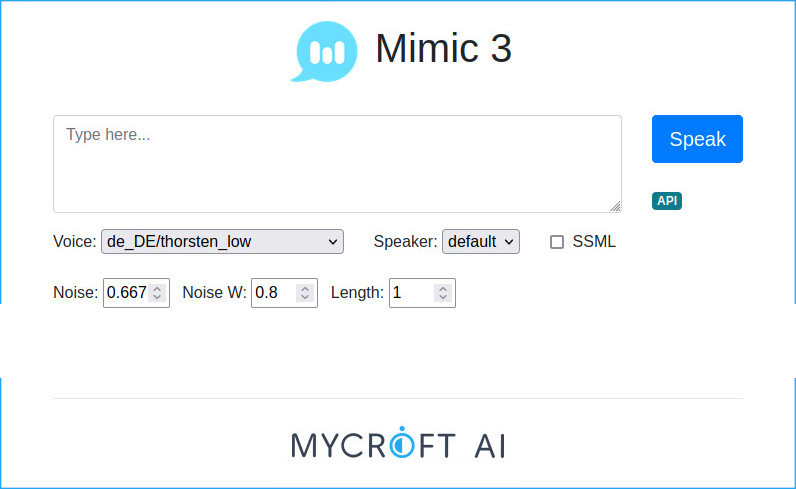
The following endpoints are available:
/api/ttsPOSTtext or SSML and receive WAV audio back- Use
?voice=to select a different voice/speaker - Set
Content-Typetoapplication/ssml+xml(or use?ssml=1) for SSML input
/api/voices- Returns a JSON list of available voices
An OpenAPI test page is also available at http://localhost:59125/openapi
See mimic3-server --help for the web server documentation for more details.
Web Client
The mimic3 program provides an interface to the Mimic 3 web server when the --remote option is given.
Assuming you have started mimic3-server and can access http://localhost:59125, then:
mimic3 --remote --voice 'en_UK/apope_low' 'My hovercraft is full of eels.' > hovercraft_eels.wav
If your server is somewhere besides localhost, use mimic3 --remote <URL> ...
See mimic3 --help for more options.
CUDA Acceleration
If you have a GPU with support for CUDA, you can accelerate synthesis with the --cuda flag when running mimic3 or mimic3-server. This requires you to install the onnxruntime-gpu Python package.
Using nvidia-docker is highly recommended. See Dockerfile.gpu for an example of how to build a compatible container.
MaryTTS Compatibility
Use the Mimic 3 web server as a drop-in replacement for MaryTTS, for example with Home Assistant.
Make sure to use a compatible voice key like en_UK/apope_low.
For Mycroft, you can use this instead of the plugin by running:
mycroft-config edit user
and then adding the following:
"tts": {
"module": "marytts",
"marytts": {
    "url": "http://localhost:59125",
    "voice": "en_UK/apope_low"
}
SSML
A subset of SSML (Speech Synthesis Markup Language) is supported.
For example:
<speak>
  <voice name="en_UK/apope_low">
    <s>
      Welcome to the world of speech synthesis.
    </s>
  </voice>
  <break time="3s" />
  <voice name="en_US/cmu-arctic_low#slt">
    <s>
      <prosody volume="soft" rate="150%">
        This is a <say-as interpret-as="number" format="ordinal">2</say-as> voice.
      </prosody>
    </s>
  </voice>
</speak>
will speak the two sentences with different voices and a 3 second second pause in between. The second sentence will also have the number "2" pronounced as "second" (ordinal form).
SSML <say-as> support varies between voice types:
- gruut
- eSpeak-ng
- epitran voices do not currently support
<say-as> - Character-based voices do not currently support
<say-as>
License
See license file